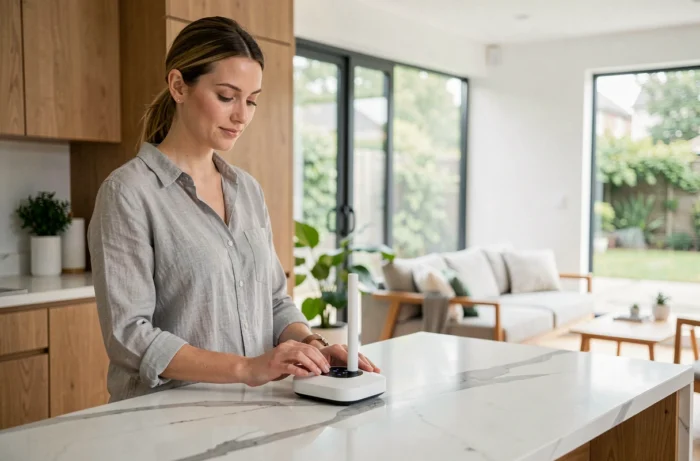
The connected home promises centralized control of lighting, heating, and security. Behind this promise, several protocols are competing for the market, recent European regulations are changing the rules of the game, and the choice of a home automation ecosystem commits you for several years. This article compares communication standards, measures the impact of new legal obligations, and details the technical points that determine the success of a connected interior.
Home Automation Protocols: Comparing Matter, Zigbee, and Z-Wave Compatibility
The communication protocol determines which devices can communicate with each other. A poor initial choice locks you into a unique ecosystem and complicates any future additions. The table below summarizes the characteristics of the three most widespread standards.
| Criterion | Matter | Zigbee | Z-Wave |
|---|---|---|---|
| Interoperability | Designed to unify brands (Apple, Google, Amazon, Samsung) | Large existing base, but pairing sometimes limited between brands | Mandatory certification between manufacturers |
| Signal Range | Mesh network via Thread | Mesh network, moderate range | Mesh network, good wall penetration |
| Recent Adoption | Netatmo and IKEA thermostat heads launched in 2026 | Still dominant in lighting (Philips Hue) | Mostly present in sensors and locks |
| Weak Point | Not all Matter devices communicate smoothly with each other yet | No native compatibility with Matter without a gateway | More limited product catalog |
Matter was supposed to unify the market, but many devices still refuse to communicate despite certification. The first Matter thermostat heads that arrived on the market often require a dedicated hub, sometimes incompatible with previous ranges from the same manufacturer.
For a modern interior, the choice of protocol determines the selection of connected lighting fixtures, LED bulbs, ceiling spots, and smart plugs. Checking the hub’s compatibility with each category of object (lighting, heating, security) remains the first concrete step before any purchase. The available resources about the Athomedia site allow for a deeper understanding of the selection criteria for each room in the house.
European Regulation and Connected Homes: What Changes in 2025-2026
Two European regulatory frameworks are directly modifying how connected objects are designed and used in homes.
Data Act: Portability of Home Automation Data
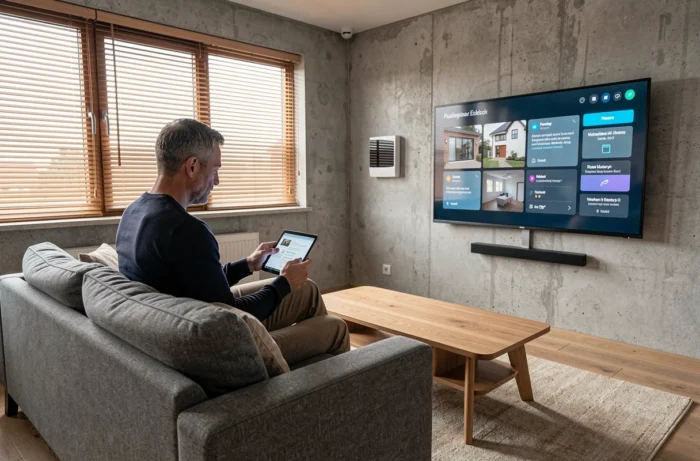
Since September 12, 2025, the European regulation on data (Data Act, EU Regulation 2023/2854) gives the owner of a thermostat, speaker, or connected appliance the right to retrieve the data generated by its use for free. This data can be transmitted to a third party, such as an independent repairer or another service.
Starting from September 12, 2026, new devices must be designed to make this data accessible by default, in a structured format. In practical terms, this means that an owner will be able to change home automation platforms without losing their heating consumption history or lighting scenarios.
RED Directive: Mandatory Cybersecurity
Since August 1, 2025, the requirements of the RED directive impose that connected radio devices (Wi-Fi, Bluetooth, 4G) better withstand network attacks, protect personal data, and limit fraud risks. Cybersecurity moves from being a best practice to a compliance criterion for any equipment sold in the European Union.
In practice, a buyer of a security camera, connected lock, or motion detector must check the RED compliance of the product. Non-compliant devices can no longer be placed on the European market.
Connected Lighting and Interior Decoration: LED, Bulbs, and Fixtures by Room
Lighting represents the most accessible entry point into home automation. Connected LED bulbs can be replaced in seconds and transform the ambiance of a living room, bedroom, or kitchen without any renovation.
- Living Room: color temperature variable bulbs allow switching from cool white for work to warm white for relaxation, controlled by scenario from an app or voice assistant
- Bedroom: LED strips placed behind a headboard or under furniture create soft indirect lighting, programmable to simulate a gradual sunset
- Kitchen: recessed spots connected above the worktop provide functional lighting, adjustable in intensity according to the activity (preparation, meals, dimmed ambiance)
- Bathroom: connected ceiling lights with motion detectors turn on automatically and turn off after a programmed delay
Connected lighting not only changes comfort but also alters the perception of space. Well-positioned indirect lighting visually enlarges a narrow room. Conversely, multiplying connected light sources on different protocols (one Zigbee bulb here, one Wi-Fi spot there) complicates centralized management.
Concrete Home Automation Scenarios: Room-by-Room Automation
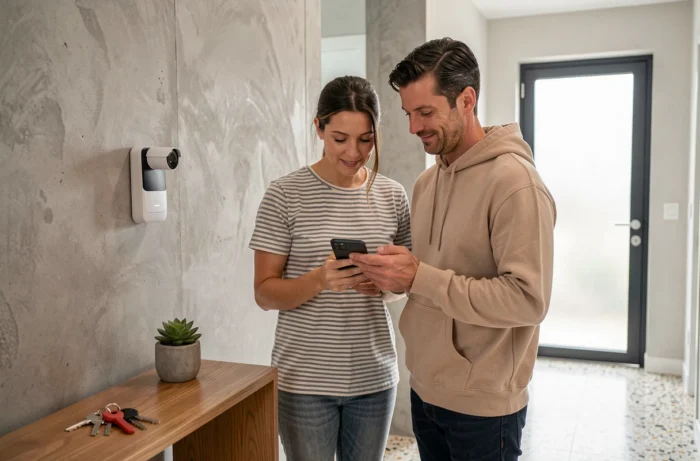
A home automation scenario chains several actions triggered by a single event. The value of a connected home does not lie in the number of installed objects but in the relevance of the configured automations.
- “Departure” Scenario: a press of a button or a voice command turns off all lights, lowers the heating by a few degrees, locks the connected lock, and activates the surveillance camera
- “Wake-Up” Scenario: the shutters open gradually, the bedroom lighting shifts to warm white at low intensity, and the programmable coffee maker starts
- “Evening” Scenario: the living room fixtures switch to dimmed mode, the temperature stabilizes, and the connected speakers play a predefined playlist
A well-designed scenario reduces daily gestures without multiplying applications. A common pitfall is installing connected objects from different brands without checking that they can be grouped into the same routine. Before adding new equipment, compatibility with the existing hub and the protocol already in place remains the determining criterion.
The key takeaway for any connected home project is summed up in one line: European regulation now mandates data portability and cybersecurity by default. Choosing a home automation ecosystem in 2026 is no longer just about comparing comfort or interior decoration features, but about ensuring that each object meets these new requirements, guaranteeing both the longevity of the installation and the protection of personal data.