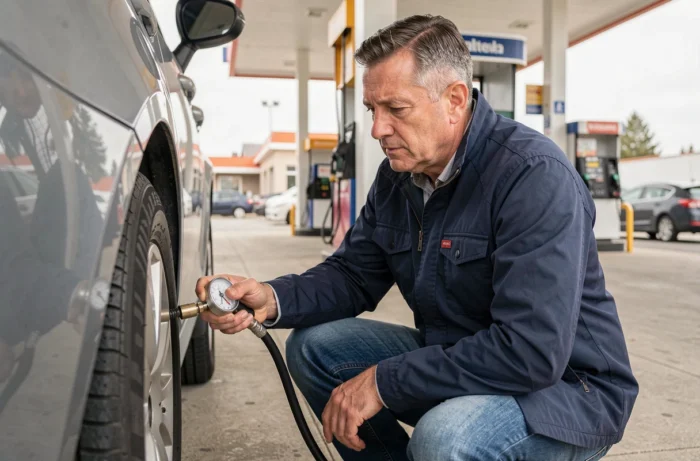
Checking tire pressure remains one of the most neglected maintenance tasks by drivers. A slight under-inflation of just a few tenths of a bar is enough to increase fuel consumption and accelerate tire wear. Finding a free air pump can be challenging, as there is no legal obligation guaranteeing free access, and the information available online is often incomplete.
Reliability of databases: what the maps don’t tell you
Several websites and applications list air pumps in France. Gonflo, for example, references over 11,000 stations. These tools make searching easier, but they have a concrete limitation.
Many pumps are listed without a specified price. The lack of information does not mean that inflation is free, nor that it is paid. Access hours sometimes depend on the opening of the adjacent business, which complicates remote verification. Gabriel France, in an article updated on September 22, 2026, confirms this gap.
In practice, the only certainty is obtained on-site. When looking for where to find a free tire inflator, it is better to cross-check multiple sources and call the station before making a detour.
Gas stations and brands: very variable pricing policies
Gas stations are the first reflex for inflating tires. The majority of the TotalEnergies network offers the service for free. However, large retail stations display more disparate practices: some brands charge for the session, while others do not, with no obvious geographical logic.
The price, when applicable, remains modest. Field reports vary on this point depending on the regions, but the cost rarely exceeds a few euros per session. Auto centers like Norauto or Speedy generally include inflation in their maintenance services, provided a technician is available at the time of the visit.
Some guidelines for choosing your pump
- Prefer stations open 24/7, especially on highway rest areas where pumps are accessible continuously, even outside service hours
- Check for the presence of a built-in pressure gauge on the pump, which allows you to read the pressure in bar before and after inflation
- Ensure that the nozzle is compatible with your tire valve, especially for specific rims or utility vehicles
CEE TRA-SE-104 sheet: free pumps in company parking lots
A little-known avenue deserves attention. The energy savings certificate sheet TRA-SE-104 provides for the funding of air pumps installed in company and community parking lots. These pumps are intended for light and utility vehicles, and the services must be free for users.
This system remains underutilized. Local authorities are starting to take it up, but the number of pumps actually installed through this mechanism is difficult to estimate. For employees who use their vehicles daily, it is a practical solution that avoids a detour to a gas station.
Company and community parking lots funded by CEE guarantee free inflation. Inquire with your employer or your town hall to see if such equipment exists nearby.
Safety of the pump and preventive measures during inflation
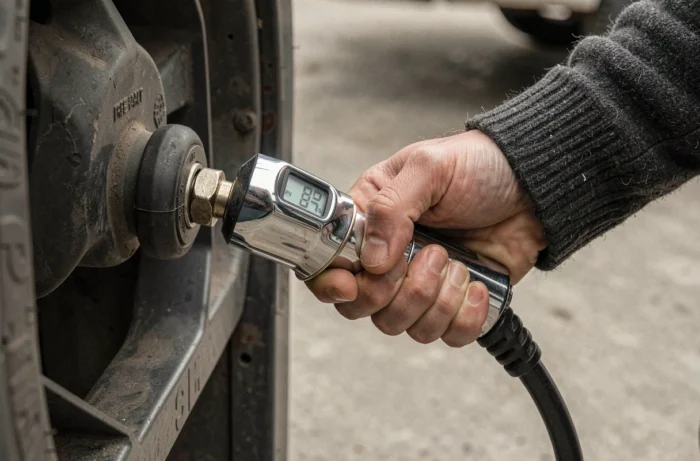
The free access to a pump does not exempt you from checking its condition. The recommendations from PréventionBTP, updated on September 25, 2026, detail the criteria for reliable equipment.
A safe pump has a pressure limiter and a target pressure setting. The remote control panel, when available, allows you to stay away from the tire during the operation. Standing in front of the tire during inflation is not recommended: in case of valve failure or bursting, debris can cause injuries.
The spare tire, a frequent oversight
Professionals recommend not limiting the check to the four mounted wheels. The spare tire should also be checked regularly, as a tire stored in the trunk gradually loses pressure over the months. Discovering it is flat at the time of a puncture turns a minor incident into prolonged immobilization.
- Check the pressure of the spare tire at least once a quarter
- Adjust the recommended pressure according to the type of tire (space-saver or full-size) by referring to the manufacturer’s label, often stuck on the driver’s door frame
- Take advantage of every visit to the pump to inflate all five tires, including the one in the trunk
Frequency of checks and recommended pressure according to the vehicle
The recommended pressure varies from vehicle to vehicle and depends on the load being transported. The manufacturer’s label indicates two values: one for regular use, one for a loaded vehicle (trip with passengers and luggage). Before a long highway trip, adjusting the pressure to the “full load” value reduces the risk of overheating and uneven wear.
The check should be done on cold tires, ideally after less than three kilometers of driving. A warm tire shows artificially high pressure, which skews the reading. Maintenance professionals recommend checking at least monthly.
Searching for a free inflator is only part of the issue. The regularity of checks matters more than the location where they are performed. A driver who checks their tires every month, even at a paid pump, better protects their tires, fuel consumption, and safety on the road than a driver who waits for a warning light to take action.