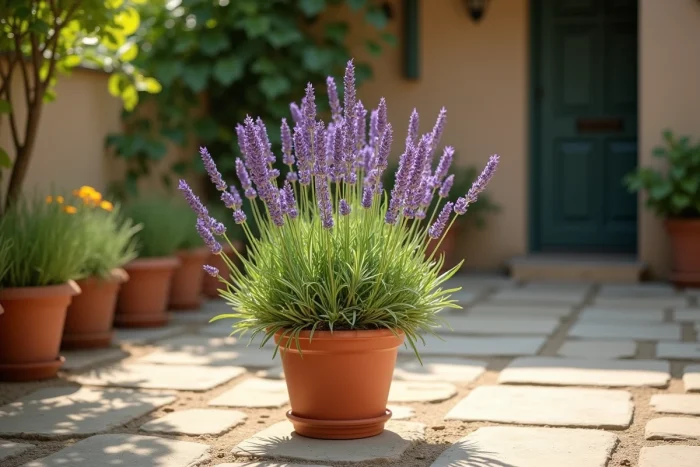
A drooping lavender almost always indicates a root or structural problem, rarely just a lack of water. Identifying the exact cause before intervening helps avoid worsening the situation, especially by adding water to a substrate that is already suffocating.
Substrate and drainage: the trap of wet collar in pots
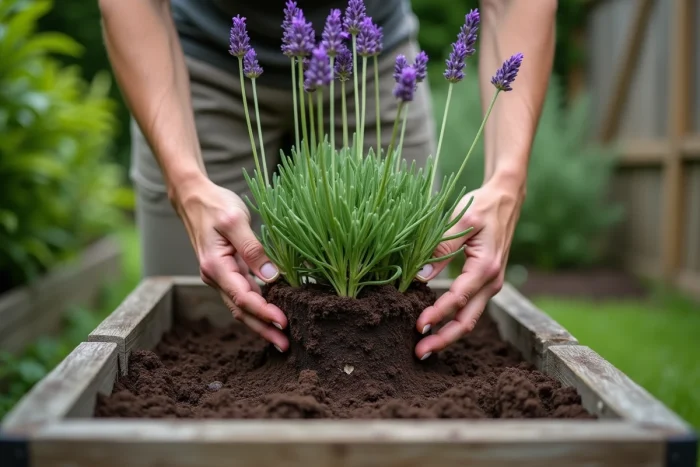
The primary cause of drooping lavender, by far the most underdiagnosed, is an excess of stagnant moisture at the collar. In the ground, clayey or compacted soil retains water around the superficial roots. In pots, the problem worsens: standard commercial substrate (peat + bark) retains moisture well beyond what a Mediterranean root system can tolerate.
We observe that the majority of potted lavenders sold in garden centers are potted in universal potting soil, which is too rich and too moisture-retentive. Within a few weeks, the saturated roots develop soft rot at the collar. The stems lose their turgor, droop, and the gardener interprets the wilting as a lack of water, which ultimately kills the plant.
The solution involves repotting in a draining mix: lean garden soil, coarse sand, and gravel, in roughly equal proportions. The pot must have wide holes, never a saucer. In the ground, if the soil is heavy, planting on a mound or slope remains the only viable long-term option. Understanding why lavender droops starts with this analysis of the substrate, before considering any other hypothesis.
Lavender that opens and droops: the woody growth after the third year
An unpruned lavender becomes bare in the center and mechanically droops. This phenomenon is not pathological. The plant produces hard wood at the base, the branches elongate, and the weight of the flower spikes pulls the stems outward. The result: a hole in the middle of the plant and branches touching the ground.
The recognized solution is double annual pruning. The first occurs just after flowering, cutting back the spikes and the upper third of the green foliage. The second, lighter, is done at the end of winter to reshape the ball. This approach, more effective than the single pruning often cited, maintains a compact form and limits mechanical breakage under the weight of the flowers.
A technical point to remember: never prune into bare wood. Lavender does not regrow on old, woody stems. If the plant is already too open with a completely woody base, replacing the plant is preferable to attempting rejuvenation. A well-maintained three or four-year-old plant covers the same area as a tall, leggy old plant.
Pruning at the right time according to the species
Lavandins (Lavandula x intermedia) can withstand more severe pruning than true lavenders (Lavandula angustifolia). Butterfly lavenders (Lavandula stoechas), on the other hand, flower on the wood of the year and do not tolerate late autumn pruning well, which removes the forming flower buds.
Thermal stress in pots: wilting without lack of water
Since recent heatwave episodes, gardening advisors have reported an increase in potted lavenders that become soft or droop, not due to overwatering, but due to overheating of the substrate in the container. A pot exposed to full sun on a concrete terrace or a south-facing balcony can reach very high internal temperatures, far beyond what a soil in the ground experiences.
In these conditions, the superficial roots undergo direct thermal stress. The plant closes its stomata, and the stems temporarily soften. The reflex to water abundantly then creates a brutal alternation between dry substrate and waterlogged substrate, which favors root pathogens like Phytophthora.
The remedy is to insulate the pot from the hot ground (elevate it on blocks, use a terracotta cache-pot rather than a black plastic one) and to water early in the morning, in small amounts, so that the substrate is moist but never soaked when the heat rises.
Quick diagnosis: excess water, drought, or fungal disease
Distinguishing the three main causes of wilting requires observing a few specific signs:
- Excess water or collar rot: leaves blacken at the base, the collar feels soft to the touch, a musty smell emanates from the substrate. The stems droop uniformly across the plant.
- Drought or heat stress: leaves gray and curl in on themselves, stems remain firm but lean. Moderate watering straightens the plant in a few hours.
- Fungal attack (Phytophthora, Rhizoctonia): wilting is asymmetrical, some branches die while others remain green. The base of the stem shows brown lesions.
In case of confirmed fungal disease, we recommend uprooting the plant and not replanting lavender in the same location for several seasons. The fungus persists in the soil.
Calcareous soil and pH: a factor often overlooked in pots
Lavender naturally thrives in calcareous soils, with a pH between 6.5 and 8. In pots, commercial potting soils are often acidic (pH around 5.5 to 6). An overly acidic substrate limits the absorption of calcium and magnesium, two elements that lavender needs to maintain the rigidity of its stems.
Adding crushed limestone or crushed oyster shells to the repotting mix corrects this imbalance. In the ground, naturally acidic soil (heath soil, forest soil) is unsuitable for lavender, regardless of drainage quality.
A drooping lavender is almost never an isolated watering problem. The substrate, pruning, thermal exposure of the pot, and soil pH interact. Correcting just one factor without checking the others amounts to treating a symptom. A well-established plant in well-draining, calcareous soil that is pruned twice a year remains compact and upright for five to seven years without difficulty.