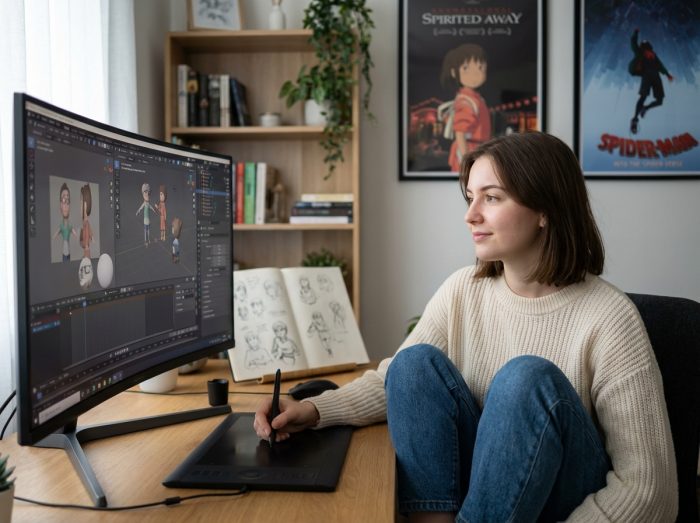
An animation studio will never ask you to be a rigging genius from day one. However, it will expect you to progress quickly and to get the hang of complex tools without delay. Some sign their first contract within six months after training; others, despite a year of experience, still struggle to find their footing. The reality is that no one is waiting to roll out the red carpet for you, but they will be watching your ability to learn quickly, adapt, and collaborate. Pipelines, software, and expectations change from studio to studio: even with a solid background, the gap between training and real production life can be surprising, sometimes brutally so.
3D Animation Today: An Evolving Profession with In-Demand Skills
The profession of 3D animator is rooted everywhere: animation studios, video games, advertising agencies. Paris, Montreal, San Francisco: here and elsewhere, 3D artists bring characters, objects, and settings to life on screen, using software like Maya, Blender, or 3ds Max. Being versatile is more important than ever.
Here’s what employers are looking for:
- the ability to master multiple tools, from rigging to physics simulation, all the way to final rendering on Unreal Engine or Cinema 4D.
This sector favors those who can learn continuously, integrate production constraints, collaborate smoothly, take feedback on board, and keep pace. In France, a beginner generally earns between €2,375 and €2,500 gross per month; the more experienced exceed €3,800. Freelance, intermittent, permanent contracts: each project imposes its own dynamics.
Job opportunities cover a wide spectrum:
- animated films
- video games
- TV series
- advertisements
Studios like Dreamworks or Disney recruit from specialized school graduates who can present an impressive showreel. Career progression can lead to the position of lead animator, or even art director.
The timeframes for mastering 3D animation after training depend on your investment, your ability to handle the tools, and your enjoyment of teamwork. Those who cross this threshold quickly stand out without a doubt.
How Long to Feel Really Comfortable After 3D Animation Training?
The path to comfort in 3D animation cannot be confined to a fixed schedule. Feedback from professionals and figures from major schools suggest that it often takes between one and two years after training to achieve true autonomy and feel confident with key software like Maya, Blender, and 3ds Max. This timeframe heavily depends on the path taken:
- Bachelor’s (Bac+3): solid technical and artistic foundation, relatively quick access to studios through internships or apprenticeships.
- MBA (Bac+5): broad vision, advanced mastery, easier integration.
- Continuing education: a preferred solution for career changes or targeted skill enhancement.
Graduating from a program with internships or an apprenticeship makes a difference: facing the pace of studios, managing deadlines, learning to integrate into a team. Many young professionals gain confidence as soon as they have completed several concrete projects; some achieve this after one year, others after two years of professional practice.
Graduates from recognized institutions find jobs quickly, especially with a well-crafted portfolio or showreel. The real skill is to handle briefs, adopt new tools, and remain curious and active in learning. Training provides the momentum, but comfort is built project by project.

Resources, Tips, and Perspectives to Accelerate Your Progress in 3D Animation
To advance more quickly after training, base your progress on robust technical skills: you need to master the tools, understand rigging, and know the basics of anatomy and architecture. Daily use of software remains the rule for every 3D animator. Stopping learning is not an option: each project presents its own challenges, requiring you to renew your techniques and methods.
But creativity is also cultivated in the margins: train your eye, explore styles, and experiment. Traditional drawing sharpens your understanding of volumes and movement, valuable qualities for bringing a character to life or energizing a scene. Patience, tenacity, agility in problem-solving, and the ability to accept sometimes blunt feedback from the team are what animation expects from you.
Focus on a selective portfolio or showreel: showcase your most accomplished projects, demonstrate the diversity of your skills, and specify your contributions to each achievement. A solid application can make all the difference, whether starting out or aiming for a more advanced position.
Don’t stay alone in front of your screen. Teamwork is learned: communicate, invite feedback, and increase exchanges to progress. Mastering stress is forged in production: tight deadlines, unforeseen events, quality demands—all of this shapes your resilience and adaptability. Studios favor those who combine passion, rigor, and constant self-reflection. That’s where the difference is made.