In the French language, some words escape the usual grammatical logic and establish themselves in spoken language long before being recognized in dictionaries. “Wallah” is among these terms whose massive use contrasts with its almost total absence in official texts.
Used in various contexts, it transcends generations and social backgrounds, while sparking debates about its legitimacy and scope. Its meanings evolve, overlap, or fragment depending on the intention, region, or language register.
A word from afar: the history and etymology of wallah
This term, now ubiquitous in discussions, owes everything to classical Arabic. Written والله, it results from the combination of the particle wa, which introduces the oath, and Allah, the name of God in Islam. Taken literally, “wallah” thus equates to “by Allah.” This phrase, pronounced to attest to the sincerity of a statement, has been rooted for centuries in the Muslim religious vocabulary.
The religious oath has always held particular significance in Islamic tradition. Saying “wallah” means putting one’s word on the line before God Himself. It is not a trivial commitment: in Islamic jurisprudence, the use of this oath is reserved for situations where the truth cannot be doubted. Lying or swearing lightly exposes one to strong condemnation from scholars, as the act can be classified as a serious sin.
But the journey of the word does not stop at the Arabian Peninsula. Wallah migrates, integrates into Persian and Turkish (“vallah”), and much later, into spoken French. Some variants like “wallah al adhim,” “by Allah the Most Great,” add solemnity. Other forms, “wallahi,” “billaahi,” “tallahi,” introduce nuances in the intensity of the oath but all stem from the same root.
To explore these evolutions in detail, take the time to browse the file “origin and usage of the word wallah” on the Topitop site, which provides a comprehensive overview of the uses and mutations of the word over time.
Why do we say wallah? Between oath, sincerity, and popular usage
The arrival of wallah in contemporary French reflects a fascinating linguistic phenomenon. Initially confined to the Muslim religious sphere, it has carved its way into popular language, particularly in urban neighborhoods and among youth. Using “wallah” means swearing by Allah, committing one’s word to the truth of a fact or a promise. This mechanism of the oath, inherited from Arab culture and Islamic law, still structures certain official contexts, such as before an Islamic judge, where the truth allows for no ambiguity.
Sincerity remains at the heart of the practice. In religious texts, the gravity of the oath is never trivialized. The scholars of Islam remind us that misusing the name of Allah for trivial matters or lying under oath is disrespectful to the sacred. This act, repeated lightly, quickly transforms into a moral and spiritual fault.
However, the expression has crossed the borders of the Muslim community. In the French suburbs, “wallah” has taken on the role of a guarantee of authenticity, regardless of religion or context. The word circulates among children, teenagers, and even reaches non-Muslim adults. It becomes an interjection or promise, sometimes detached from any spiritual dimension, but always to emphasize the strength of a statement or assertion.
Here are some typical situations where “wallah” can be encountered and how it is perceived depending on the context:
- In an Islamic court, “wallah” is used only in cases of absolute necessity to guarantee the truth.
- In informal discussions or on social media, the word serves as a marker of intensity or group belonging, but its religious use is discouraged, even criticized.
| Context of use | Religious status | Social status |
|---|---|---|
| Before an Islamic court | Allowed if absolutely necessary | Guarantee of truth |
| Casual conversation, social media | Discouraged or even forbidden | Marker of intensity or belonging |
The journey of wallah in the French language highlights the tension between the sacred and the profane. A true passport of sincerity, the word now navigates between devotion, spontaneity, and the codes of popular culture.
Expressions and contexts: how wallah enters everyday language
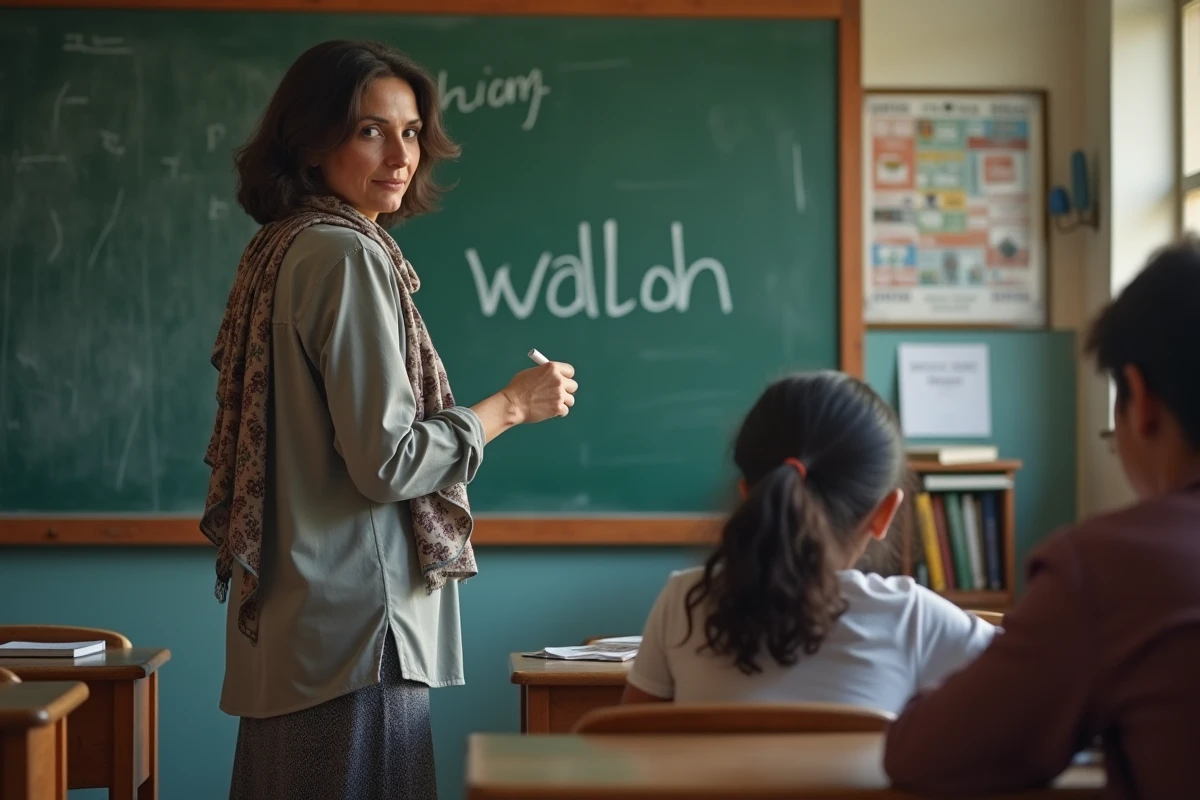
In France, wallah has established itself in everyday language far beyond its religious roots. It is heard in schoolyards, family conversations, on sports fields, in viral videos, and on social media. Derived from Arabic vocabulary, it has been adopted by urban youth, propelled by French rap and cultural figures like Sofiane or PNL.
“Wallah” now serves as oral punctuation, a tool to certify a statement or seal a promise among friends. At school, in the mouths of the younger ones, it replaces “I’m not lying,” “it’s true,” while traversing different registers depending on the context, serious or ironic, solemn or light.
A notable fact: wallah does not stop at the borders of religion. It establishes itself as a common reference in urban culture. Other phrases exist, “I assure you,” “honestly,” “believe me,” but none offer the same strength or camaraderie as “wallah.”
This word invites itself everywhere: in informal French, it rhythms exchanges, inspires lyricists, and infiltrates movie dialogues. Its immediate and lively use illustrates the vitality of popular language and its ability to welcome, divert, and propagate expressions from elsewhere. “Wallah” is no longer just a word: it is a signal, a pact, a banner of sincerity displayed loudly, sometimes seriously, sometimes just to make a point. The language has not finished absorbing its weight, nor playing with its codes. Who knows how far this word will travel yet?