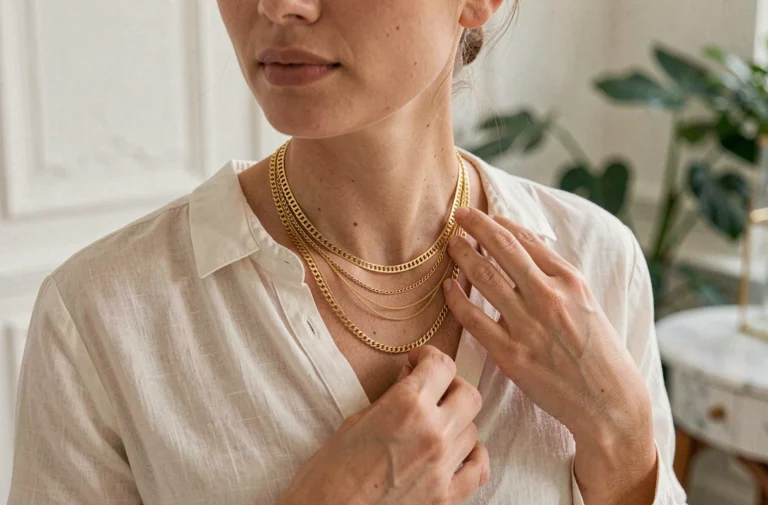
The sternum piercing is a surface piercing placed on the flat bone located between the two breasts. Unlike piercings that go through a fold of skin (navel, ear), it rests on a flat and mobile area, which radically changes the healing constraints and the choice of jewelry. Before making an appointment, some technical knowledge can help assess whether this piercing suits your body type and lifestyle.
Sternum Piercing and Mechanical Tensions: Why Rejection is Common
On a flat area like the sternum, the skin does not form a natural fold. The jewelry is held in place only by a thin layer of subcutaneous tissue. Every movement of the torso, every friction from clothing exerts a pull on the anchor points.
According to the resources of the Association of Professional Piercers (APP), surface piercings have a higher risk of migration than traditional piercings. The sternum accumulates several aggravating factors: respiratory movements, pressure when lying down, bra straps, seat belts.
Rejection manifests as a gradual closing of the two openings, with thinning and redness of the skin around the jewelry. Once this process begins, it is rarely reversible. Removing the jewelry in time limits the residual scar. Waiting too long leaves a more visible elongated mark. Finding advice on sternum piercing tailored to your situation helps identify these signals before they worsen.

Implant-Grade Titanium: The Reference Material for Sternum Piercing
The choice of jewelry directly affects your body’s tolerance. Two options dominate the market, but they are not equal for a surface piercing.
Why Titanium and Not Surgical Steel
Stainless steel 316L contains nickel. On a piercing in a friction area, prolonged contact with this metal regularly causes contact eczema reactions. Implant-grade titanium does not release nickel and remains the material recommended by the APP for initial placements, especially for people with sensitive skin.
<p Niobium is a biocompatible alternative but is less common among piercers. 14 or 18 karat gold without nickel alloy can also be suitable, provided its exact composition is verified with the professional.
Jewelry Shape and Anchoring
For a surface piercing on the sternum, two types of jewelry coexist:
- The staple-shaped bar (surface bar), designed to fit the curvature of the skin with its two ends at 90 degrees, which reduces lateral pressure on the openings.
- The microdermal (single subcutaneous anchor), whose flat base is fixed in the dermis by a single point. The result is more discreet, with only one point visible on the surface.
- The curved bar (banana), sometimes used but less suitable: its curvature exerts constant tension outward, which accelerates migration on a flat area.
The piercer adjusts the length of the jewelry to the available skin thickness. A jewelry piece that is too short compresses the tissues, while one that is too long catches on clothing. Both scenarios promote rejection.
Sternum Piercing Care: An Adapted Healing Protocol
The healing of a surface piercing on the sternum generally takes longer than that of an earlobe. The area is constantly stressed, which slows down the formation of the skin tunnel.
Daily Cleaning Without Over-Treatment
A sterile saline solution applied twice a day is sufficient for the first few weeks. Aggressive antiseptics (Betadine, alcohol, hydrogen peroxide) destroy regenerating cells and delay healing.
Concrete procedure: soak a sterile compress in saline solution, apply to each opening for one to two minutes, then gently dry by dabbing with a clean compress. Bath towels should be avoided, as their fibers catch on the jewelry.
What Delays Healing
- Sleeping on your stomach: direct pressure on the jewelry for several hours each night is the primary cause of avoidable complications.
- Synthetic body-hugging clothing: they retain moisture and create continuous friction. Prefer loose cotton during the healing phase.
- Prolonged baths (pool, jacuzzi, bubble bath): stagnant water and chemicals promote bacterial infections on an unhealed piercing.
- Handling or twisting the jewelry: contrary to popular belief, twisting a surface piercing does not speed up healing. It introduces bacteria and irritates the forming tissues.

Warning Signs and Limits of Surface Piercing on the Sternum
Slight redness and sensitivity are normal in the first few days. However, certain signals should prompt a quick consultation with the piercer or a dermatologist.
A thick, yellowish or greenish discharge, accompanied by local warmth and increasing pain, suggests an infection. Never remove an infected piece of jewelry without professional advice: removal can trap the infection under the skin by closing the openings.
Migration can be visually detected. If the skin between the two openings appears thinner than at the time of placement, or if the jewelry seems to be “moving up” towards the surface, the rejection process is likely underway. The piercer may then recommend removal to limit scarring.
Skin prone to keloids (excessive scarring forming lumps) presents an additional risk in this area. Those affected should discuss this with a dermatologist before placement, as the sternum is an area where keloid scars frequently recur.
The sternum piercing remains a unique aesthetic choice, but its longevity depends as much on post-placement follow-up as on the quality of the initial procedure. Choosing an experienced piercer in surface piercings, accepting implant-grade titanium jewelry, and adhering to a rigorous care protocol are the three factors that separate a successful piercing from premature rejection.